
Bible Study Topics Every Wednesday Night 6:30 PM Eastern Time
Evergreen Church of God in Christ Worship Center
Invites you to join our Wednesday Night Bible Study, presented on Zoom - at 6:30 pm Eastern Time
Zoom Link:
Meeting ID: 875 3702 5063 Passcode: 598785
One Tap Mobile: 1.646.876.9923 Meeting ID: 875 3702 5063# Passcode: 598785#
Scroll beyond for summary and video clip of the lesson

Key Outcomes
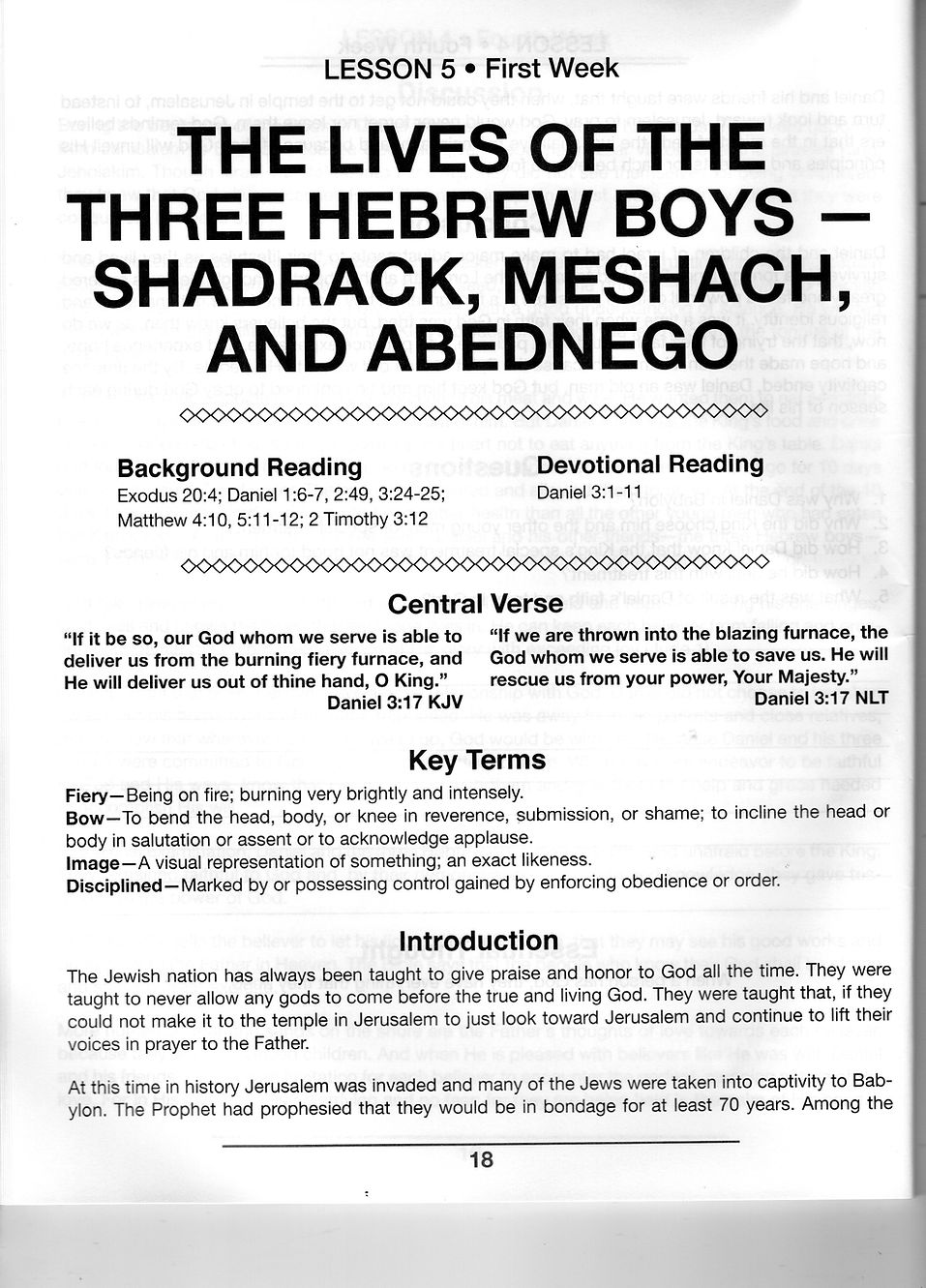
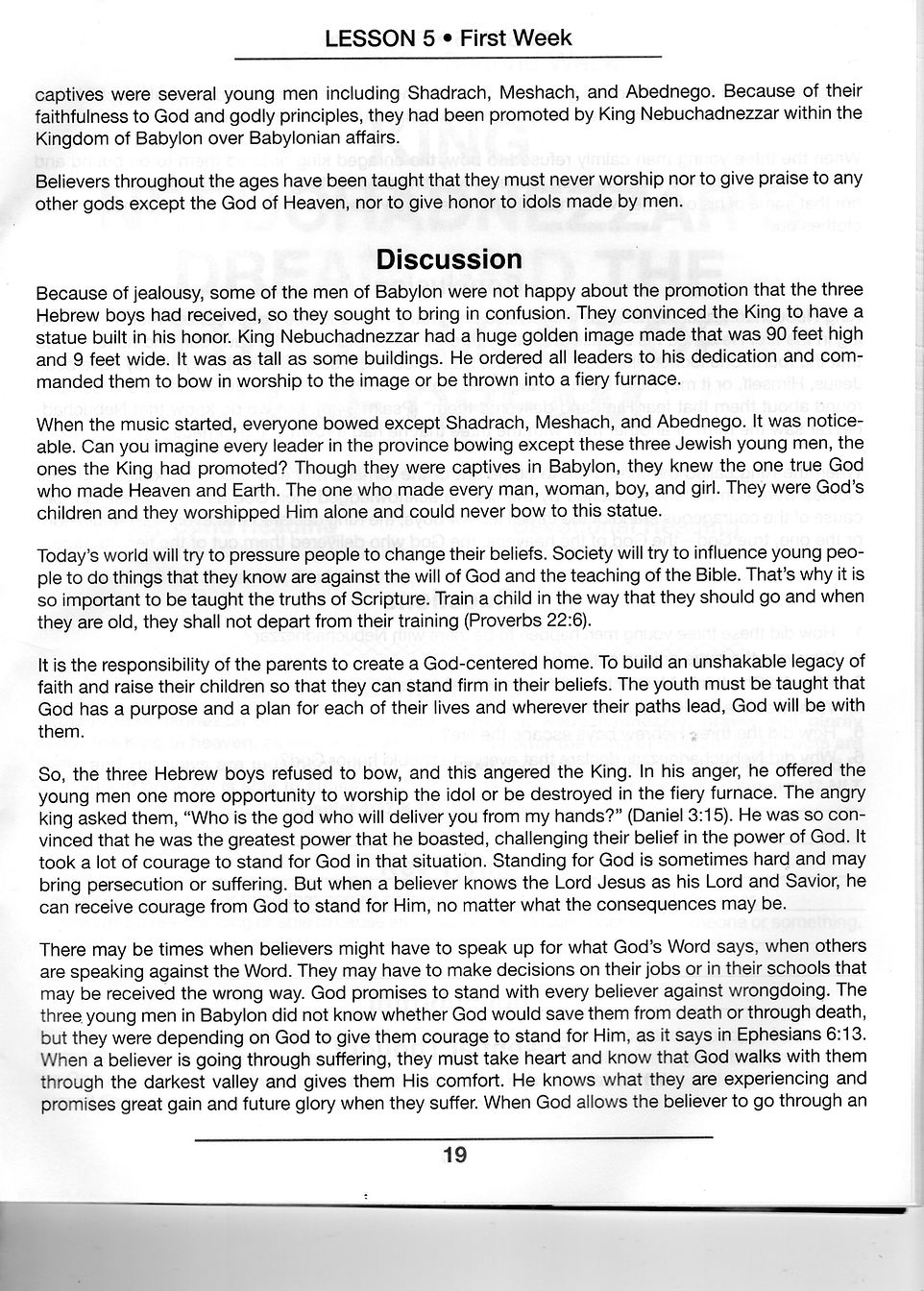
This Bible study session covered Lesson 5 on the three Hebrew boys — Shadrach, Meshach, and Abednego — as a continuation of a series on young people of faith in the book of Daniel. The group explored themes of unwavering faith under pressure, cultural identity, idolatry in modern life, and the cost of standing firm for God. Central to the discussion was Daniel 3:17, emphasizing absolute confidence in God's ability to deliver even when the outcome is uncertain. Participants drew extensive connections between the Hebrew boys' experience in Babylon and the challenges facing believers — especially young people — in contemporary society.
Youth Presentation: Answering the Macedonian Call
A video was shown of a Representative from the New York Eastern First Ecclesiastical Jurisdiction at the 76th Women's Convention in the Purity Class.
Key Points from Her Presentation:
-
Drew from Acts 16:19 — the Macedonian Call — as a metaphor for the cry of today's youth for help and guidance.
-
Young people face social media pressure, anxiety, peer pressure, identity struggles, and constant expectations to succeed; many smile outwardly while struggling inwardly.
-
Youth need mentors who listen, teachers who believe in them, parents who encourage them, and leaders who point them in the right direction.
-
Answering the call is not only for adults — youth also have a responsibility to support each other through kindness, prayer, and inclusion.
-
Answering the call means stepping outside comfort zones, noticing when someone is hurting, and using voices, talents, and faith to bring light.
-
She also received an award at the Girls Rock event recognizing young women's achievements, college plans, and biographies.
Icebreaker Discussion Highlights
Participants responded to five reflective questions connecting the lesson to personal experience:
Godly Adult Influence:
-
Participant cited his father's example and character as foundational — even after straying, the upbringing caused him to return.
Biggest Concerns for Teenagers Today
-
LGBTQIA identity struggles and the challenge of helping young people find their identity in God rather than cultural movements. 1
-
Social media access as a major obstacle to young Christians standing firm.
-
Truthfulness and peer pressure — Participant noted that her teenage grandson struggles with honesty, and emphasized the connection between lying and further moral compromise.
-
Persuasion through social media and television making it difficult for young people to hold to biblical standards when "everybody's doing it."
What Would Help You Say Yes to God at Great Personal Cost
-
Salvation as assurance — knowing you are saved provides the eternal security that makes temporal sacrifice worthwhile.
-
A direct, sure word from God — personal divine confirmation would be the deciding factor, especially regarding physical safety.
Qualities God Looks for in Young People
-
The same qualities expected of adults: holiness, uprightness, honor, truth, and being saved.
What makes it hard for young Christians to stand:
-
Social media, identity confusion, and the normalization of compromise were cited
Background Scriptures and Their Application
Scripture - Connection to Lesson
Exodus 20:4 - Foundational commandment against idolatry the basis for the Hebrew boys' refusal to bow
Daniel 1:6-7 - Introduction of the four young men and their Babylonian name changes
Daniel 2:49 - Shadrach, Meshach, and Abednego elevated to govern the province of Babylon
Daniel 3:24-25 - Nebuchadnezzar witnesses four men in the fire, the fourth like the Son of God
2 Kings 20:14-18 - Hezekiah's pride leads to the prophesied captivity of his descendants
/ Isaiah 39:5-8
Matthew 4:10 - "Thou shalt worship the Lord thy God and Him only shalt thou serve"
Matthew 5:11-12 - Blessed are those persecuted for righteousness; great is their reward in heaven
2 Timothy 3:12 - All who live godly in Christ Jesus shall suffer persecution
1 Peter 4:12-13 - Do not think it strange concerning fiery trials; rejoice a partakers of Christ's sufferings
Core Lesson: The Three Hebrew Boys
Context and Captivity
-
Daniel, Hananiah, Mishael, and Azariah (later renamed Shadrach, Meshach, and Abednego) were members of Judean royalty, taken as captives to Babylon.
-
Their captivity was prophesied and precipitated by King Hezekiah's pride — he showed Babylonian envoys all the treasures of his palace, and Isaiah warned that everything seen would be carried away, including the king's descendants.
-
They were children/young men sent into captivity for the sins of the adults around them, not their own wrongdoing.
-
Hezekiah's response — "Good is the word of the Lord... for there shall be peace and truth in my days" — reflected self-centered indifference to future generations. 2 Kings 20:14-18 / Isaiah 39:5-8
Name Changes as Cultural Erasure
-
The Babylonians deliberately changed their names to sever their connection to God and their heritage:
-
Daniel ("God is my judge") → Belteshazzar "Bel protects his life" or "Favored by Bel" (honors the god Bel)
-
Hananiah ("God has been Gracious") → Shadrach ("The Command of Akku" — honors Aku, the moon god)
-
Mishael ("who is what God is") → Meshach ("who is what Aku is?")
-
Azariah ("the Lord has helped") → Abednego ("servant of Nebo/Nagu")
-
-
The purpose was to wean them from their faith, erase their religious identity, and assimilate them into Babylonian culture and religion.
-
Outcome: Changing their names did not change their character — they remained rooted in their faith.
-
God's sovereignty is evident: what was intended to destroy their identity instead became a testimony still discussed today.
The Fiery Furnace Narrative
-
King Nebuchadnezzar erected a golden image 90 feet tall (equivalent to a 9-story building) on the plain of Dura, commanding all to bow when music played.
-
Jealous Chaldeans reported Shadrach, Meshach, and Abednego for refusing to bow — highlighting envy as a recurring danger when believers stand out.
-
The king gave them one final chance: bow or be thrown into a furnace heated seven times hotter than normal.
-
Their response (Daniel 3:17 KJV): "Our God whom we serve is able to deliver us from the burning fiery furnace, and He will deliver us out of thine hand, O King" — and even if He does not, they would still not bow.
-
They were thrown in bound and fully clothed; the soldiers who threw them in died from the heat.
-
Nebuchadnezzar witnessed four men walking freely in the fire, the fourth described as like the Son of God.
-
They emerged completely untouched — no singed hair, no smell of smoke.
Key Theological Observations
-
God did not remove the heat — He met them in the fire. The furnace was still burning at full intensity; God's protection was total despite the danger remaining.
-
The fourth man in the fire is interpreted as a type of Christ — Emmanuel, God with us in suffering.
-
God's deliverance is total and complete: what the enemy intends for destruction, God uses for testimony (Romans 8:28).
-
Nebuchadnezzar's statue was not merely political — it was a spiritual counterfeit, as Satan always creates counterfeits to pull people away from true worship.
-
After witnessing the miracle, Nebuchadnezzar decreed that the whole nation must honor the God of Israel, demonstrating that personal faithfulness can shift an entire nation's spiritual climate.
Modern Applications Discussed
Idolatry in Contemporary Life
-
A participant raised the question of whether the Pope functions as a human idol, given the millions who flock to him and treat him as supreme.
-
Pastor's response: People look to the Pope before looking to Christ; they see him as all-supreme rather than as a connection to Jesus, and bow and cry in his presence.
-
Superintendent added: The same dynamic applies to followers of the Honorable Elijah Muhammad, who regard him with equivalent reverence.
-
A participant shared a personal example: she realized she had been making an idol out of her children's father by consistently elevating his image — God directly convicted her of this.
-
Conclusion: You can make an idol out of any person or thing; believers must know the difference and respect positions without worshipping the people who hold them.
Music as a Tool of Manipulation
-
The king used music as a trigger to command worship — when people heard it, they knew to bow.
-
Pastor connected this to Romans 10:17: faith comes by hearing — the enemy knows that hearing is a powerful tactic to capture attention and direct behavior.
-
A participant noted that Satan was the music worshiper in heaven and continues to use music to manipulate — pointing to the content of music young people consume today.
-
Warning: It is not only music but sound effects and appealing speech — things that sound good but are not biblically viable can lead believers astray.
Standing Firm in Everyday Life
-
Praying over food in public (restaurants, fast food) as a small but meaningful act of standing for God without shame.
-
Refusing to drink alcohol at a work Christmas party while others do — small acts of standing out for faith.
-
Separating from certain friends and situations that compromise faith — the same principle the Hebrew boys applied.
-
Not showing everything you have to outsiders — Hezekiah's mistake of revealing his treasures is a warning against boasting about God's blessings to those outside your faith.
Key Theological Insights from Participants
-
The Hebrew boys were deeply rooted and grounded in their faith from childhood — instructed under Jewish law about food, idol gods, and worship. This foundation made them immovable.
-
What is outstanding is that these young men never lost their cultural teaching — unlike many young people who stray when they go to college or get a job, they refused to let their different location change what they believed.
-
God divinely chose Nebuchadnezzar to be king of that era (Jeremiah 29:4-8); he simply didn't know how to handle the blessing. Nebuchadnezzar's recognition of the Son of God in the fire was a divine revelation — Jesus was not yet known or written about in that context.
-
Referenced Daniel 11:32 — "They that know their God shall be strong and do exploits" — as the foundation for the Hebrew boys' boldness.
-
Before Daniel interpreted Nebuchadnezzar's dream, he and his three friends held an all-night prayer meeting (Daniel 2:17-19). The secret was revealed to Daniel in a night vision only after they prayed together — prayer must come before everything.
-
The Hebrew boys' experience connects to 1 Peter 4:12-13 — believers should not think it strange to face fiery trials; God will be glorified at the end.
Decisions Made
-
God's standard is universal: The qualities God looks for in young people are identical to those expected of adults — holiness, uprightness, integrity, and truthfulness — with no generational exemption.
-
Personal obedience has public impact: One act of faithfulness by three individuals changed the spiritual climate of an entire nation; the same principle applies today.
-
Isolation leads to compromise: The group affirmed that community and accountability are essential; the Hebrew boys stood together, and believers today must identify who is standing with them.
In-Depth Discussion Questions (For Personal Reflection)
Participants were given the following questions to take home and meditate on:
-
Why was it jealousy that triggered the crisis for the Hebrew boys?
-
What does it say about Babylon's climate that the king needed music to get people to bow?
-
The fire was heated seven times hotter — why didn't God stop the king from making it hotter?
-
Who was the fourth man in the fire, and why does it matter?
-
Their clothes, hair, and even the smell of smoke were untouched — what is God saying through that detail?
-
Because of their faithfulness, Nebuchadnezzar decreed the whole nation must honor their God — how does personal obedience have public impact?
-
What is the statue in your life right now, and what does it demand of you?
Take-Home Application Points
-
Identify your furnace: What situation is currently demanding you compromise your faith — your job, family, finances, or social pressure?
-
Know God's character: Trust God for who He is, not only what He has done — build your theology before the crisis hits.
-
Commit before the music plays: The Hebrew boys had already decided before the moment of temptation arrived; make faith decisions in advance.
-
Find your community: Isolation leads to compromise — identify who is standing with you.
-
Your fire has an audience: When you come through your furnace, someone who watched you go in will be changed by seeing you come out — people are watching how you govern yourself through trials.
-
Count it all joy: Even in messy trials, God is watching and will reward faithfulness.