
Bible Study Topics Every Wednesday Night 6:30 PM Eastern Time
Evergreen Church of God in Christ Worship Center
Invites you to join our Wednesday Night Bible Study, presented on Zoom - at 6:30 pm Eastern Time
Zoom Link:
Meeting ID: 875 3702 5063 Passcode: 598785
One Tap Mobile: 1.646.876.9923 Meeting ID: 875 3702 5063# Passcode: 598785#

Scroll beyond for summary of the lesson
Key Outcomes of the Class:
Key Vocabulary Defined
-
Sovereignty — God has supreme power; He is free from outside control; no one controls God
-
Unprecedented — Never done before; the virgin birth is the primary example cited — it has never happened before or after
-
Predictable — Able to be told ahead of time; God told believers in advance so they can trust Him when prophecy is fulfilled
-
Redemption — To buy back; to save from sin; to fix what is broken, likened to paying a price to free a slave
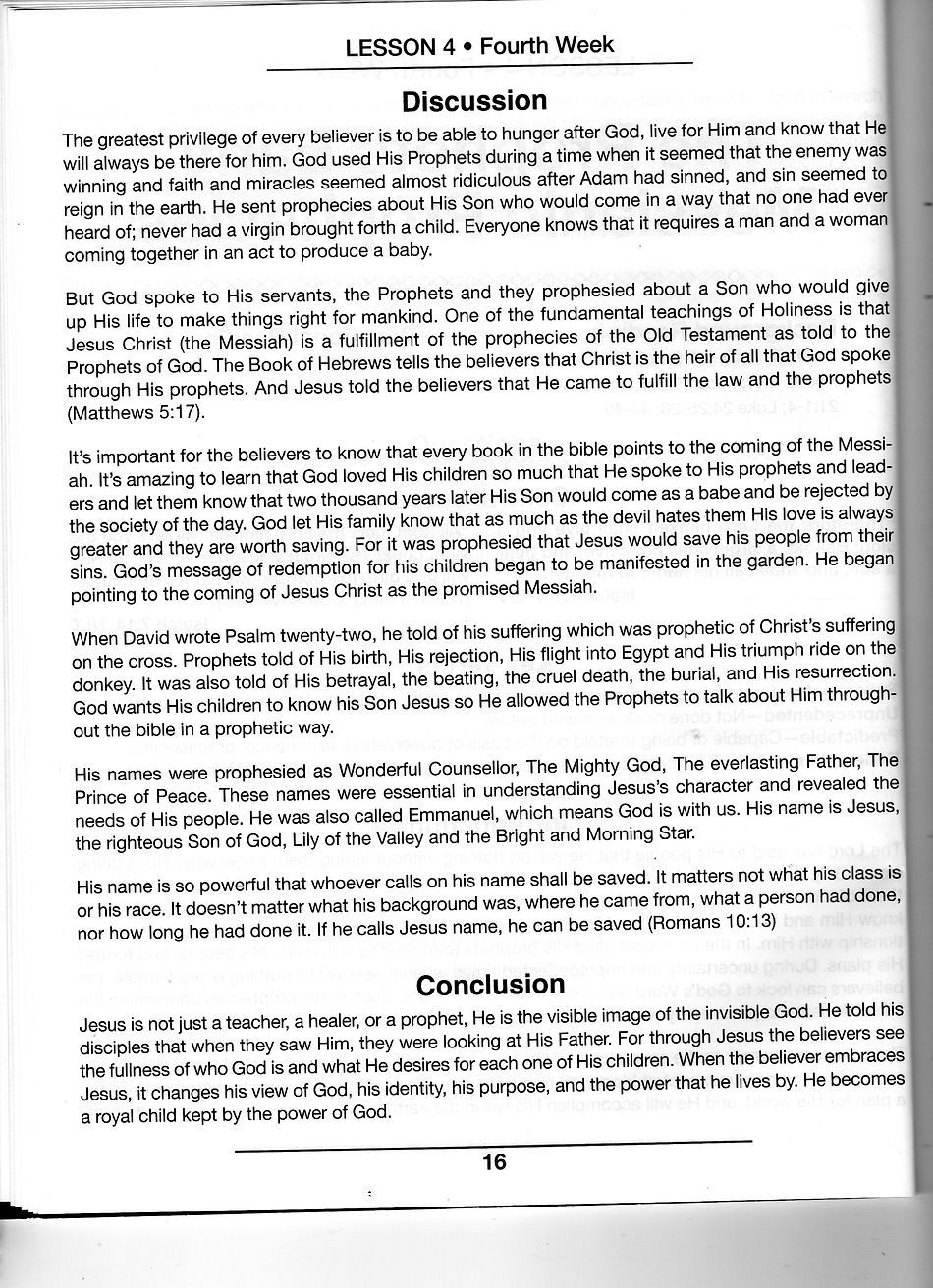
The introductory anchor verse was Amos 3:7: "Surely the Lord God will do nothing, but He reveals His secret to His servants, the prophets." The lesson's interpretive frame: God does not want believers confused; He wants them aware of what is happening, especially in uncertain times
Isaiah: The Prince of Prophets
Identity and Context
-
Name meaning: Yeshayahu — "Yahweh is salvation"; his name matches his message: God saves
-
Period: 740–681 BC, Jerusalem, southern kingdom of Judah; served under four kings — Uzziah, Jotham, Ahaz, and Hezekiah; contemporary of Micah
-
Titles given to Isaiah: Eagle Eye Prophet (referenced from a prior lesson), Prince of Prophets, Greatest of the Prophets, Messianic Prophet, and the Shakespeare of the Prophets
-
Why "Prince of Prophets": He has 66 chapters, matching the 66 books of the Bible
-
Why "Messianic Prophet": He contains more messianic prophecies than any other prophet
Isaiah 7:14 — The Virgin Birth Sign
-
Historical context: King Ahaz (age 20) was terrified because Syria and Ephraim were advancing on Jerusalem in 734 BC. God told Ahaz to ask for a sign; Ahaz refused with false humility, so God declared He Himself would give the sign.
-
The sign: "A virgin shall conceive and bear a son, and shall call his name Emmanuel." Hebrew word alma = young woman of marriageable age who has never known a man — a true virgin, not merely a young woman
-
Emmanuel = "God with us" or, as Sister Reese preferred, "With us is God" — emphasizing the connotation that God is present among His people
-
Butter and honey: Clarified as curds (yogurt, cottage cheese, sour cream), not modern table butter — produced by fermenting milk. The significance: an Assyrian invasion destroyed farmland; olive trees take 20 years to grow, grapes take 5 years. With crops gone, the land reverted to pasture for wild goats, sheep, and bees — curds and honey became the diet, signifying both judgment and God's provision in a desolate land.
-
Immediate fulfillment: Before the child (Emmanuel) was 2–3 years old, the two kings Ahaz feared — Syria and Ephraim — would be gone. This was fulfilled 734–732 BC.
Isaiah 8:1–4 — Mahershala Hashbaz (The Timer Child)
-
Name meaning: "Speed to spoil / Swift to spoil / Hasty to pray / Haste to pray"
-
Identity: Second son of Isaiah; born to Isaiah's wife, the prophetess
-
God's instruction: Before the child was born, God told Isaiah to write this long name on a scroll and take two faithful witnesses — Uriah the priest and Zechariah, son of Jabarakiah (identified as likely the father-in-law of the king, distinct from Zechariah the prophet)
-
Prophetic significance: Before this child could say "Abba" (father) or "Ima" (mother) in Hebrew, Assyria would take Damascus and Samaria — fulfilled 732 BC 15
-
Lesson drawn: God gives short-term proof so we can trust His long-term promises. This is the definition of "predictable" in action — Ahaz and Israel could trust the ultimate virgin birth 700 years later because they first saw these near-term prophecies fulfilled.
Isaiah 9:6 — A Child Born, a Son Given
Extended Hebrew word study of the names in this verse:
-
"A child is born" = human; "a son is given" = eternal — He always existed
-
"Government shall be upon his shoulder" = He carries weight not in hands (which can drop) but on shoulders as a burden bearer
-
Wonderful (Pele in Hebrew) = supernatural, beyond human comprehension; same word used for the angel's name in Judges 13:18, where the angel said his name was "secret" — Sister Reese noted this connection as striking
-
Counselor (Yowit) = He does not need counsel; He is perfect counsel
-
Mighty God (El Gabor / Gibor) = mighty champion, warrior, hero, valiant man; this is His full deity — the child is God the warrior Himself, not merely godly, but God
-
Everlasting Father (Abiad / Abi-Ad) = Father, possessor, source of eternity; father who creates and owns eternity; not the first person of the Trinity, but the one whose fatherhood never ends
-
Prince of Peace (Sar Shalom) = Sar means prince, ruler, captain, chief, governor; Shalom means wholeness, completeness, welfare, soundness — not merely the absence of war; He rules by making us whole
Synthesized application of the names — each name meets a different need:
-
Wonderful → when confused
-
Counselor → when needing wisdom
-
Mighty God → when weak
-
Everlasting Father → when feeling abandoned
-
Prince of Peace → when anxious
-
Emmanuel → when lonely
-
Jesus → when lost in sin
-
Lily of the Valley → when in the valley
-
Bright and Morning Star → when it is dark
Micah: The Poor People's Prophet
Identity and Context
-
Name meaning: "Who is like the Lord?" — and the answer, as the group confirmed together, is no one
-
Period: 735–700 BC; from Moresheth Gath, 25 miles southwest of Jerusalem, in the low country (Shephelah); contemporary of Isaiah 19
-
Isaiah vs. Micah: Isaiah is described as the city preacher; Micah as the country preacher
-
Titles: Poor People's Prophet (defends the poor against corrupt leaders), Prophet of Social Justice, Country Prophet, Prophet of the Bethlehem Prophecy
-
Historical backdrop: Northern Kingdom fell to Assyria in 722 BC; Judah threatened by Sennacherib in 701 BC
Micah 5:2–4 — Bethlehem
Prophecy
-
Text: "But thou, Bethlehem Ephratah, though thou be little among the thousands of Judah, yet out of thee shall come forth unto me that is to be ruler in Israel, whose goings forth have been from old, from everlasting."
-
Bethlehem = house of bread; Ephratah = fruitful; little = small
-
Theological point: God chooses a small, insignificant town to demonstrate supreme power and sovereignty — this is the definition of "unprecedented"
-
"Goings forth from everlasting" = Jesus has an eternal origin; He was not created; He always existed — this affirms His deity
-
Verse 3: God will give Israel up until the time she who travails has brought forth — a pause between rejection and the kingdom; Israel set aside until the birth
-
Verse 4: He shall stand and feed his flock in strength — the Shepherd King who makes small people safe and gives security 21
-
New Testament fulfillment: Matthew 2 — the chief priests quoted Micah 5:2 directly to Herod when asked where the Messiah would be born; Christ was born in Bethlehem exactly as foretold
Hosea: The Living Parable
Identity and Context
-
Name meaning: Hoshea = salvation, deliverance; same root as Joshua and Jesus — God saves
-
Period: 750–722 BC; Northern Kingdom, Israel/Ephraim; last days before Assyria carried them away; contemporary of Isaiah
-
Titles: Prophet of Love, Prophet of Mercy, Deathbed Prophet of the North, Living Parable
-
"Living Parable": God commanded Hosea to marry Gomer, an unfaithful wife, as a visible picture of Israel's spiritual adultery — everyone in town knew Gomer's reputation, making Hosea's family a walking sermon
The Children's Names as Prophetic Statements
In biblical times, names were prophetic statements about a person's mission:
-
Jezreel — named after the valley where Jehu massacred the house of Ahab; signaled God would end the dynasty of Jeroboam II and punish bloodshed with bloodshed. Every time the child's name was called, it reminded the community of divine judgment.
-
Lo-Ruhamah — "no mercy / no pity"; the suspension of compassion
-
Lo-Ammi — "not my people"; a direct reversal of the covenant formula in Exodus and Leviticus: "Ye shall be my people, and I will be your God"
Israel's Spiritual Adultery
-
Israel's sin was not merely rule-breaking but framed as a marital betrayal — chasing after Baal, the Canaanite storm and fertility god, for economic security (crops and children), while cheating on Yahweh, her covenant husband
-
Gomer was eventually sold into slavery; Hosea had to go and buy her back — a direct picture of redemption
Hosea 11:1 — Out of Egypt
-
Text: "When Israel was a child, then I loved him and called my son out of Egypt." — historically referring to the Exodus
-
Matthew 2:13–15 fulfillment: Joseph took the child Jesus to Egypt; stayed until Herod's death — "that it might be fulfilled which was spoken by the prophet, Out of Egypt have I called my son"
-
Type and antitype explained: Israel is the type (picture) — the son who failed in the wilderness, murmured, and worshiped idols. Jesus is the antitype (real thing the picture points to) — the true Son who succeeded where Israel failed, retracing Israel's steps: water baptism (like the Red Sea), 40 days in the wilderness (tempted without sin), then ministry
-
Application: Not everyone who sounds religious has sincere motives — Herod claimed he wanted to worship Jesus but intended to kill Him; believers need discernment
-
Sovereignty lesson: God used even Herod's deception to direct the wise men away from Bethlehem and fulfill Micah 5:2, then sent the family to Egypt to fulfill Hosea 11:1
Zechariah: The Visionary Prophet
Identity and Context
-
Name meaning: "Yahweh remembers / the Lord remembers" — covenant kept even when people forget
-
Period: 520–518 BC, post-exilic; returned from Babylon in 538 BC; temple rebuilding had stopped — Haggai and Zechariah motivated the people to rebuild
-
Titles: Prophet of Restoration, Messianic Prophet, Visionary Prophet
-
Eight night visions: horses patrolling the earth, horns and craftsmen, measuring line for Jerusalem, Joshua the high priest with filthy garments made clean, lampstand with two olive trees, flying scroll, woman in basket (wickedness), four chariots
Zechariah 9:9 — The Triumphal Entry
-
Text: "Behold, thy king cometh unto thee, just and having salvation, lowly and riding upon a donkey, upon a colt the foal of a donkey."
-
Hebrew word study:
-
Melek = sovereign king; Sadiq = just, righteous; Yasha = savior, bring salvation; Ani = humble, afflicted; donkey (kammer/chammer) = beast of peace, not war; colt = never ridden by man, preserved for this purpose
-
-
Donkey vs. horse: A king riding a horse signals war; riding a donkey signals peace, meekness, and a peaceful mission
-
New Testament fulfillment: Matthew 21:1–4 — Jesus sends two disciples to retrieve a donkey and colt; they bring them; Jesus rides into Jerusalem exactly as prophesied
-
First vs. second coming: First coming on a donkey = peace; second coming on a white horse (Revelation 19:11) = power and judgment
Psalm 22: Prophecy of the Crucifixion
-
Author: David; written approximately 1,000 years before the crucifixion
-
Crucifixion context: Crucifixion was invented by the Persians and refined by the Romans — yet David described it in precise detail 800 years before the Romans refined it
-
Structure: Lament (verses 1–21) → Praise (verses 22–31); movement from forsaken to finished
Specific fulfillments cited:
-
Verse 1: "My God, my God, why have you forsaken me?" — Jesus quotes this on the cross (Matthew 27:46)
-
Verses 7–8: Mockers laughing, shooting out the lip, shaking their heads, saying "He trusted the Lord, let Him deliver him" — fulfilled in Matthew 27:39–
-
Verse 16: "They pierced my hands and my feet" — written 1,000 years before crucifixion existed (John 20:25)
-
Verse 18: "They part my garments among them and cast lots upon my vesture" — soldiers gambling for Jesus's clothes (John 19:23–24; Matthew 27:35)
-
Verse 22: "I will declare your name unto my brethren" — cited in Hebrews 2:12
-
Verse 31: "He has done this" — Hebrew Asa = "it is done"; parallels Jesus's words in John 19:30: "It is finished"
Key verse — Psalm 22:24: "For he has not despised nor abhorred the affliction of the afflicted; neither has he hid his face from him; but when he cried unto him he heard." Pattern for prayer: Complaint → Ask → Trust → Praise → Tell others
Sister Reese's reflection on generational faith: If a prophetic word takes 1,000 years to be fulfilled, would anyone call the prophet false? With a generation estimated at 20–30 years, roughly 33–50 generations of people would have to carry and transmit that word forward before seeing its fulfillment — a profound testimony to the faithfulness required of God's people.
Luke 24 — The Road to Emmaus: Synthesis and Summary
-
Luke 24:25–26: Jesus calls the disciples on the road to Emmaus "fools" — Greek anoetos, meaning "unthinking," not an insult but an observation that they believed in the glory prophecies (Micah 5, Zechariah 9) but skipped the suffering (Psalm 22, Isaiah 53)
-
Correct order: Suffer, then glory; cross, then crown
-
Verse 44: Jesus states that all things written in the law of Moses, the prophets, and the Psalms concerning Him must be fulfilled — Psalm 22 is the Psalms portion; Isaiah, Micah, Hosea, Zechariah are the prophets portion
-
Why Jerusalem first? Three reasons given:
-
Prophetic — Isaiah 2:3; Micah 4:2: out of Zion shall go forth the law and word of the Lord
-
Theological — Salvation is of the Jews (John 4:22; Romans 1:16); atonement happened where blood was shed and resurrection verified
-
Practical/Redemptive — Jerusalem was the place of greatest failure (they denied and abandoned Jesus there); God starts a mission of grace precisely where the failure was greatest. The city that killed the Messiah was the first to hear forgiveness in His name.
-
-
Verse 49: "Behold, I send the promise of my Father upon you; tarry in Jerusalem until you be endued with power from on high." — the promise of the Father = the Holy Spirit; tarry = wait; endued with power = the Spirit
Group Discussion: Q&A on Lesson Questions
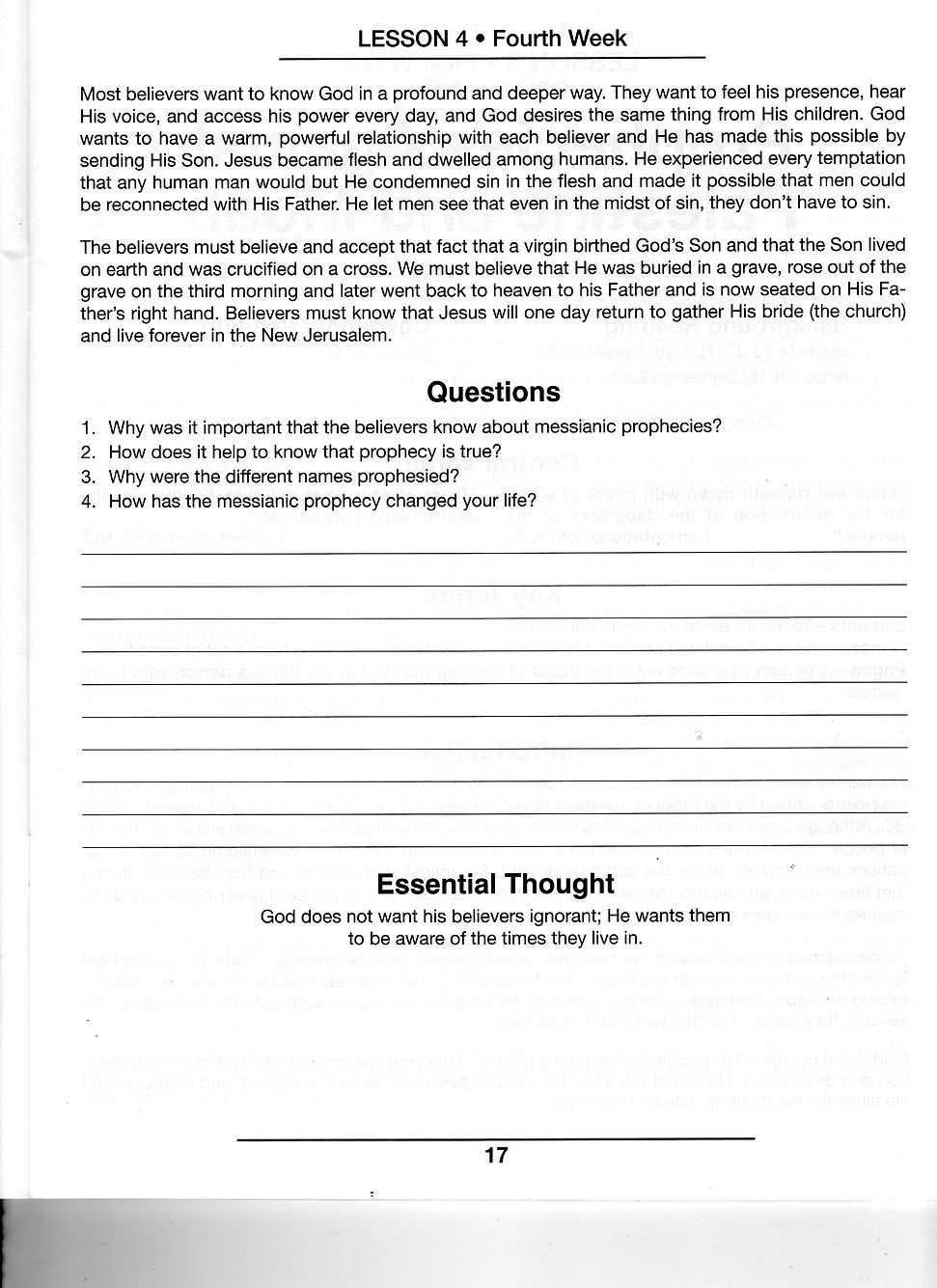
Question 1 — Why is it important for believers to know about messianic prophecies?
-
So believers are not ignorant of the times (Amos 3:7 — God reveals His secrets)
-
Shows God's love is greater than the devil's hate
-
Believers are worth saving; precise fulfillment builds faith
-
God told believers ahead of time so they could recognize fulfillment when it comes; we are living in times where the Bible is coming to life, including events in Revelation
Question 2 — How does it help to know that prophecy is true?
-
Prophecy without fulfillment has no validity; when God's prophecies come true, it gives clear, precise knowledge of what He is saying
-
God gives short-term proof so believers can trust long-term promises — the same way enslaved people spoke of a day of freedom they never lived to see, but small victories (e.g., drinking from a formerly segregated fountain) gave evidence that God is able
-
The Holy Spirit bears witness with the word; when a word of prophecy is given, the Spirit confirms its truth
Question 3 — Why were the different names prophesied?
-
Each name has significance and reveals character — in biblical times, names were prophetic statements about mission and identity
-
Names of God (Jehovah Jireh, Jehovah Nissi, Jehovah Rapha) were given at different moments to match different needs — cross-referenced to Isaiah 53:5 ("with his stripes we are healed")
-
The names reveal the character of God — people needed Him to be wonderful, a counselor, mighty; these names describe His nature, and He does not change
-
One name is not enough to describe the Savior; He cannot be summed up in a single word
-
Acts 4:12 cited: "Neither is there salvation in any other; there is not a name given among men whereby we must be saved" — His name is salvation itself
-
Bethlehem means house of bread, Ephratah means fruitful — and from that location came Jesus, who is later known as the Bread of Life; the significance of names continues to speak today
-
To call on the name is to call on the person behind the name; above all names is Jesus
Question 4 — How has messianic prophecy changed your life?
-
Studying the nature and characteristics of Jesus gives understanding of who He really is; the song "To Be Like Jesus" takes on deeper meaning when you study His actual character
-
Messianic prophecy gives hope — knowing the Messiah and all the benefits of salvation means believers have an anchor for their souls; instead of despair or mental illness, there is a Counselor; instead of suicide, there is a Comforter; we are more than conquerors through Him who loved us
-
Bishop O.T. Jones's phrase — "Don't you know you're free?" — captures the freedom available through the Messiah; Matthew's Gospel is particularly focused on the messianic Jesus
-
Psalm 2:7 is an additional messianic witness: "Thou art my Son; this day have I begotten thee"